Surpassing Industry Standards

Major events, from mass-participation and high-profile sporting fixtures to festivals, present a unique challenge and opportunity when it comes to transport. Thousands, and often millions, of journeys are concentrated into short timeframes, placing pressure on local networks while significantly influencing an event’s overall carbon footprint.
Across the events industry, transport, albeit Scope 3, typically accounts for the majority of associated carbon emissions. The challenge lies in reducing flights for international events and private car use for domestic audiences, whilst increasing public transport and active travel, and evidencing this to measure associated carbon reductions. It’s not only about delivering modal shift, but measuring it, explaining it, and using it to push continuous improvement for events and transport infrastructure alike.
This is where ‘You. Smart. Thing.’ (YST) plays a critical role.
Understanding the difference in travel behaviour
When looking at national (UK) averages for travel behaviours, we see that driving is by far the most dominant mode of transport. Personal car use typically accounts for around 60% of journeys in the UK, with public transport under 10% and multi-modal journeys (for example, cycle to train) often not accounted for [1].
Everyday travel behavioural insights such as these provide useful context in relation to how people typically travel on a daily basis. However, major events operate in a fundamentally different transport environment [1].
Road closures and diversions are common. Specific access points for different ticket types are the norm. Routes to and from transport interchanges are often overly congested. Hence, spectators are often more willing to walk further distances. The reality of finding parking discourages private car use. Public transport services can be enhanced and promoted, often complemented by bespoke shuttle services. This all plays a role in opening up further opportunities to nudge people towards sustainable travel. Communications can also be highly targeted and time-bound, presenting significant opportunities to bring travel planning higher up the audience agenda.
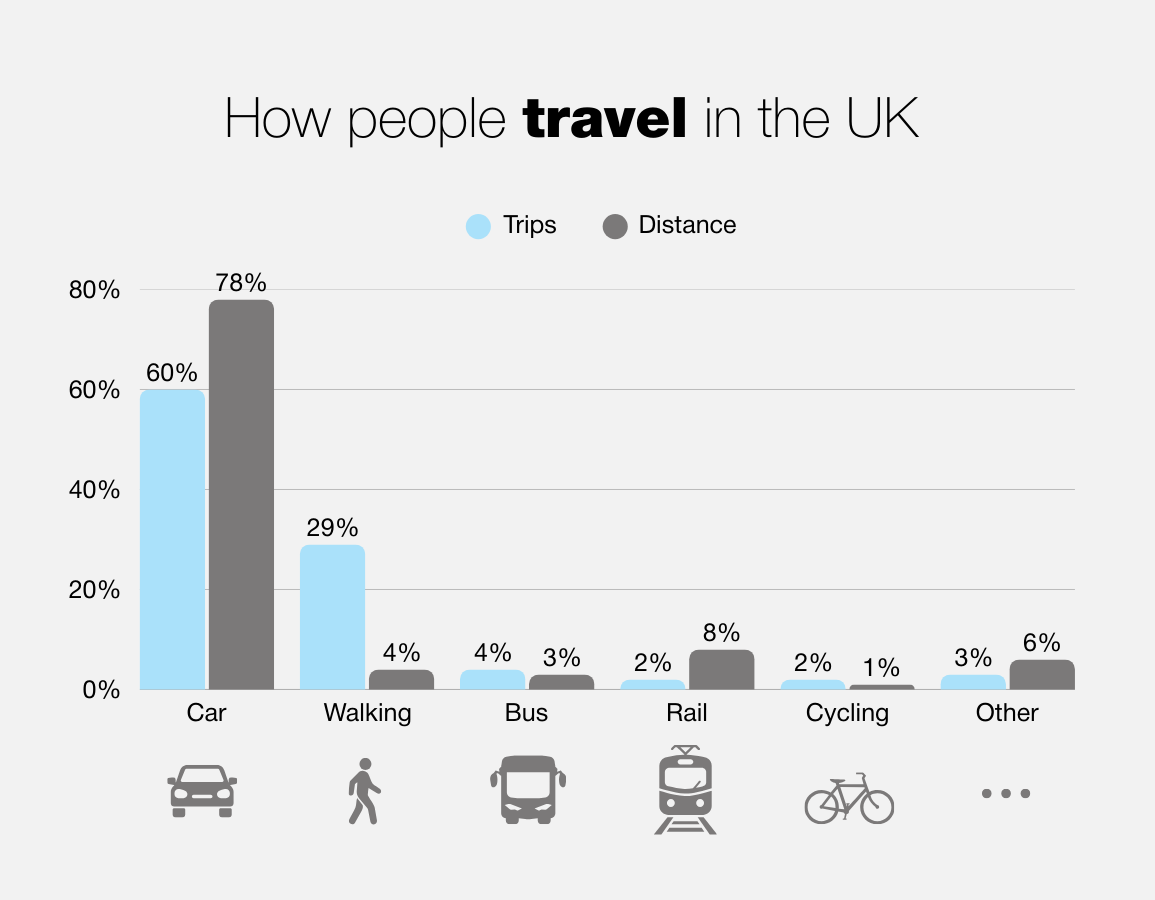
(Source: Adapted from UK Department for Transport, National Travel Survey 2023, showing distribution of trips and distance by travel mode [1].)
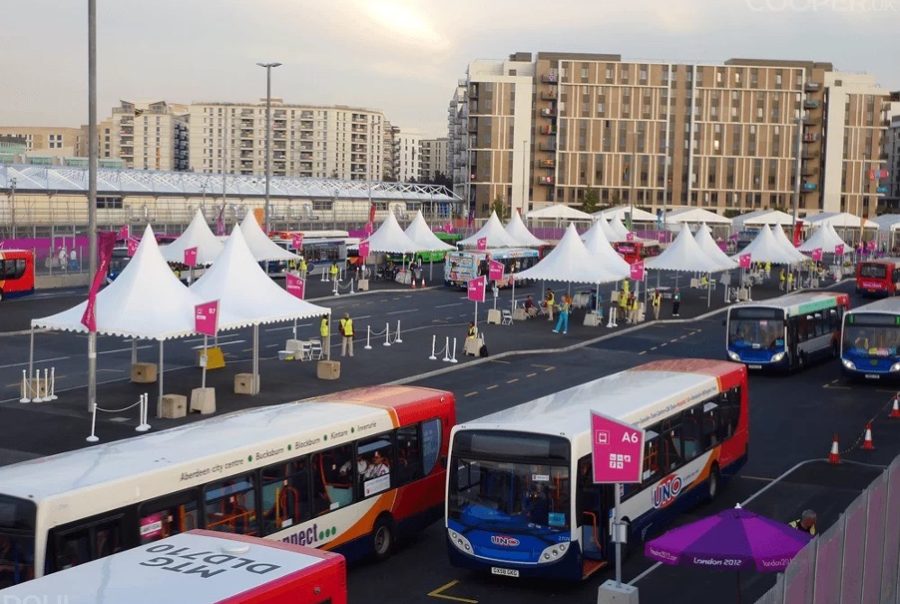
(London 2012 transport planning prioritised public transport and active travel [2])
What Major Events Can Achieve
Historic major events demonstrate what is possible when travel is planned strategically. Take two of the most familiar sectors as examples, sports and festivals:
London 2012 transport planners aimed for almost 100% of spectators to arrive by public transport, walking or cycling, dramatically reducing private car traffic around venues [2].
Large UK festivals, such as Glastonbury and Boomtown, have demonstrated that 30–40% or more of attendees arrive via public transport, shuttle or active travel, when sustainable travel is prioritised.
Across the spectrum of major events, research consistently shows measurable shifts toward public transport and walking on event days, compared with normal travel patterns.
So, events can and should outperform everyday travel norms. The key to achieving this is setting clear targets, providing the right travel planning tools, and tracking trends and behaviours in an effective way.
Turning Ambition into Action: How YST Supports Events
YST works with event organisers to move beyond generic aspirations and towards defined, measurable outcomes.
1. Setting Modal Shift Targets
Successful event travel planning starts with goal setting and modal shift targets. YST supports events to define modal split KPIs during scoping and reporting workshops, aligned to the event context and local infrastructure.
Examples might include:
- 70–80% public transport and active travel for centrally located urban events
- 30–40% public transport and active travel for events in semi-rural locations
- 30% minimum uptake of event-commissioned shuttle services
By agreeing these targets early, modal split becomes a strategic performance metric leveraged by smart travel planning, not just a retrospective statistic.
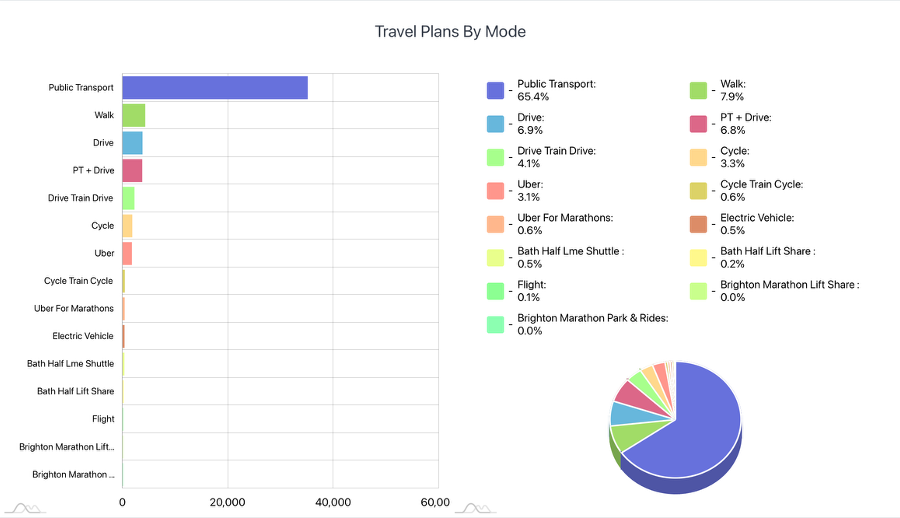
(Example: a very impressive modal split from London Marathon Events, viewed from the YST Dashboard)
2. Driving Engagement Through Planning
YST delivers a tailored event travel assistant that goes beyond journey planning. It is a behaviour-change intervention based on a personalised visitor travel plan with clear analytics to support feedback.
Travel plan query metrics allows organisers to:
- Track audience engagement over time
- Assess the impact of specific communications such as email campaigns, ticket releases, and social posts
- Identify peaks in interest linked to key milestones
By pairing this with a comparative review of communications and travel plans, YST helps events understand how messaging converts into desired actions. This turns engagement into KPIs that can be managed, rather than passively observed.
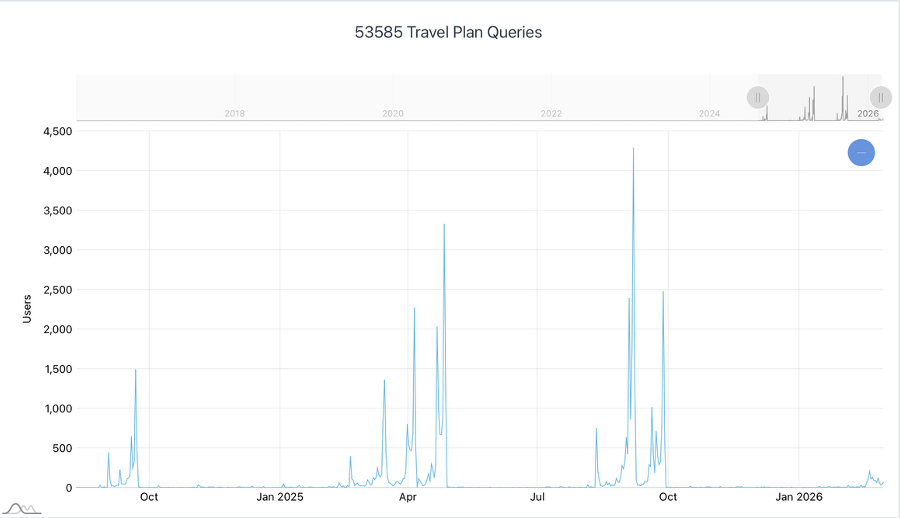
(Example: Travel Plan Queries are highly reactive to communications.)
3. Measuring Modal Split and Working to Shape It
Modal split data only becomes powerful when it is properly contextualised.
YST’s dashboard supports events to:
- Compare actual event travel behaviour against pre-set targets
- Benchmark performance against similar events and previous years
- Understand gaps and service and opportunities for additional transport operator yield and revenue
- Demonstrate how event travel differs from everyday travel patterns
For many events, achieving a public transport or active travel share that significantly exceeds national averages is a clear indicator of success, and a strong story for stakeholders, host cities and sponsors.
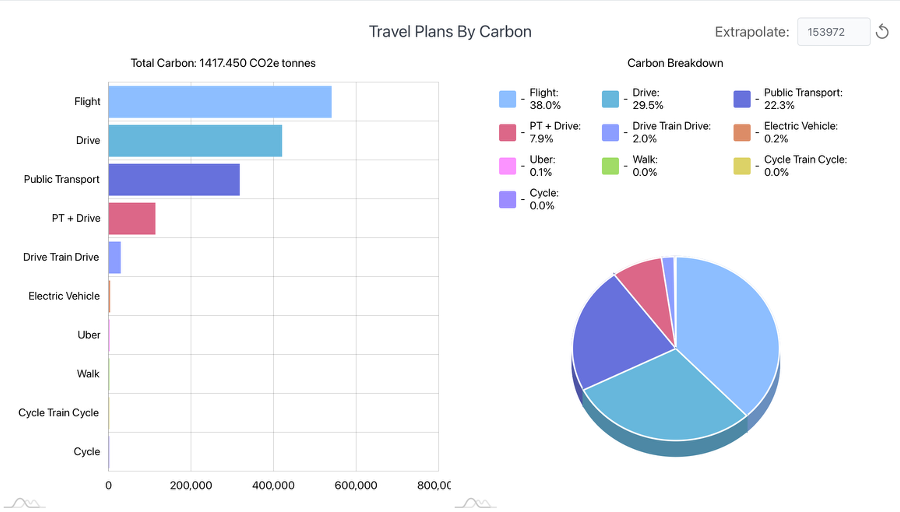
(Example: Travel-related carbon impact by mode, based on event travel data.)
4. Translating Behaviour Change into Environmental Impact
Scope 3 transport emissions are increasingly central to sustainability reporting.
YST’s CO₂e emissions analytics allow organisers to:
- Estimate total travel-related emissions at a high level
- Monitor progress against emissions-reduction goals
- Extrapolate results to the full audience once engagement exceeds approximately 30%, providing a robust evidence base
By working closely with organisations on their wider carbon strategies, YST ensures this data is credible, transparent and easily integrated into reporting.
From Data to Leadership
Major events have a powerful opportunity to set new standards when it comes to travel behaviour.
With YST, events can:
- Define realistic but ambitious modal shift targets and monitor year on year
- Actively influence how audiences and the public travel
- Demonstrate measurable reductions in transport emissions
- Leverage sustainable travel as an opportunity to reduce operational cost
- Catalyse improved visitor experience and revenue generation
- Build a compelling evidence base for funders and partners to invest in travel planning, and for local authorities to improve local transport infrastructure
In an industry under growing pressure to decarbonise, travel is one of the most visible and impactful areas where events can lead.
‘You. Smart. Thing.’ does not just help shift how people travel. It is a platform to enable 360 degree audience engagement, and to catalyse and evidence change.
References
[1] UK Department for Transport (2024). National Travel Survey 2023 Factsheet.
Available at: https://assets.publishing.service.gov.uk/media/66c5c0b6cbe60889bddd278d/nts-2023-factsheet.pdf
[2] UK Parliament Transport Committee (2012). Transport and the Olympics.
Available at: https://publications.parliament.uk/pa/cm201012/cmselect/cmtran/writev/tog/m26.htm