
A Wake-up Call for Major Events

When we look back on great World Cups, we don’t remember transport plans or congestion models. We remember moments. James Rodríguez’s volley. Iniesta’s late winner. Mbappé versus Messi. Brazil in 2010. Colour, energy, and a sense of place that inspired many of us to travel later in life. And yes, even Frank Lampard’s wrongly disallowed goal. The frustration belongs on the pitch.
As the FIFA World Cup 2026 approaches, spread across three countries, 16 host cities, and an expanded format, there’s a growing risk that something else starts competing with those memories: the stress of simply getting there.
England Fans Are Lucky — Others Won’t Be
Not all World Cup journeys are created equal. An England supporter following a group-stage run of Dallas, Boston, and New York will travel roughly 2,800 kilometres, generating around 360 kg of CO₂e (the equivalent of about 800 footballs).
That’s not insignificant, but it’s manageable.
Compare that with fans following teams whose matches are widely dispersed. An Algeria fan, travelling Kansas City → San Francisco → Kansas City, could rack up nearly 4,800 kilometres and over 600 kg of CO₂e before the knockouts even begin.
A Colombia fan, moving between Mexico City, Guadalajara, and Miami, faces border crossings, time-zone shifts, and a rapidly escalating travel footprint. Particularly if their team advances to cities like Toronto, Atlanta, or Kansas City.
In true worst-case scenarios, fans could exceed 10,000 kilometres of travel during the group stage alone. That’s more than a tonne of CO₂e (over 3,000 footballs’ worth) before the tournament has properly taken shape.
Same competition. Same ticket prices. Radically different journeys.


The Journey Is Not a Side Issue
With the cost of attending a World Cup higher than ever, expectations around the overall experience are rightfully high. Exceptional visitor experiences don’t start at kick-off — they start when fans begin planning their journey.
And this is where travel demand management becomes critical.
Missed kick-offs due to unclear travel advice.
Fans stranded by last-mile congestion.
Overloaded transport systems never designed for sudden, global demand spikes.
Stress at borders and unfamiliar intercity connections.
These experiences linger. They shape how fans remember not just the match, but the host cities and the tournament as a whole.
Transport shouldn’t be the story. But when it fails, it inevitably becomes one.
World Cups Should Inspire Travel — Not Exhaust It
At their best, major tournaments encourage exploration.
Brazil 2010 did that brilliantly. The football was unforgettable, but so was the sense of place. It inspired people to return, years later, long after the final whistle.
Even Qatar 2022, despite well-documented criticisms, benefited from geographic coherence. One country. Manageable distances. Fans could attend multiple matches in a day. The tournament felt contained.
That containment matters more than we often admit.
The 2026 World Cup, by contrast, is defined by scale without cohesion.
More teams. | More matches. | More host cities. | Multiple borders and time zones.
Expansion itself isn’t the problem. The challenge is that demand is being expanded faster than it is being managed.


The Travel Demand Management Gap
Unlike single-city finals or compact tournaments, the World Cup generates sustained, moving peaks of demand over more than a month. Yet much of the current planning remains fragmented — city by city, venue by venue.
Some host cities are highly car-dependent. Others lack high-frequency public transport to stadiums. In certain locations, daily transit capacity measures in the hundreds per hour, while matchday demand will arrive in the tens of thousands.
This isn’t a criticism of individual cities; it’s a structural issue.
Without coordinated travel demand management — understanding where fans are coming from, when they will travel, and what realistic options exist — organisers are left reacting to congestion rather than shaping outcomes.
Carbon is part of this too. Travel dominates the footprint of major events, yet too often emissions are calculated after the fact. By then, the opportunity to influence behaviour has passed.
What “Good” Looks Like for 2026 — and Beyond
It doesn’t have to be this way.
A well-managed major event:
- Anticipates travel demand early and across the full footprint of the event
- Shapes when and how people travel, not just where they go
- Provides clear, tailored, and realistic travel options long before matchday
- Coordinates across cities, borders, and transport operators
- Keeps the fan experience — confidence, clarity, comfort — front and centre
Done well, travel becomes invisible. Fans arrive informed, prepared, and excited. The focus stays where it belongs: on the football, the atmosphere, and the shared experience.
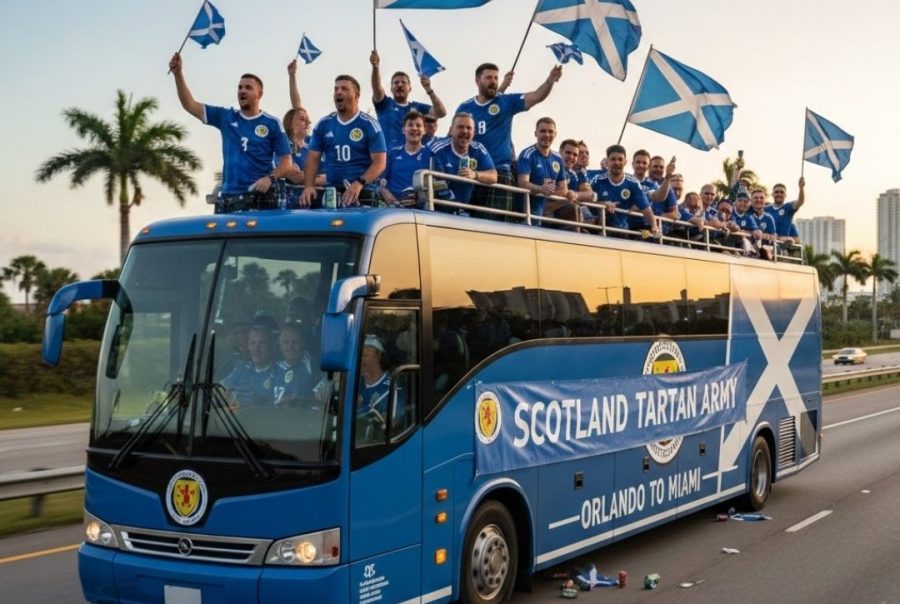
(Image source)
A Defining Test for Major Events
The FIFA World Cup 2026 will be judged on goals, drama, and unforgettable moments. But it will also be judged on whether millions of fans — regardless of geography — can move safely, efficiently, and sustainably between matches.
What happens in North America will not exist in isolation. From UEFA EURO 2028 to the FIFA World Cup 2030, future competitions will be shaped by the successes and failures of 2026. The latter is already set to span multiple countries and continents. The lessons, good or bad, are likely to influence how travel is planned, managed, and communicated at major football events for the next decade.
England fans may be lucky. Others won’t be.
And that’s why travel demand management is no longer a technical detail or a post-event calculation. It is central to how major events are experienced, remembered, and justified in an era of rising costs and climate scrutiny.
Let refereeing decisions provide the controversy. Let football provide the frustration. And let transport quietly do its job — so it never becomes the headline.
Written by Luke Orr
Sustainable Travel Consultant